
The Labor Market Is Cooling. The Workforce Challenge Is Not.
Reni Snider, Sr. Account Executive, Libertate Insurance
Last week, the Bureau of Labor Statistics released its July employment report.
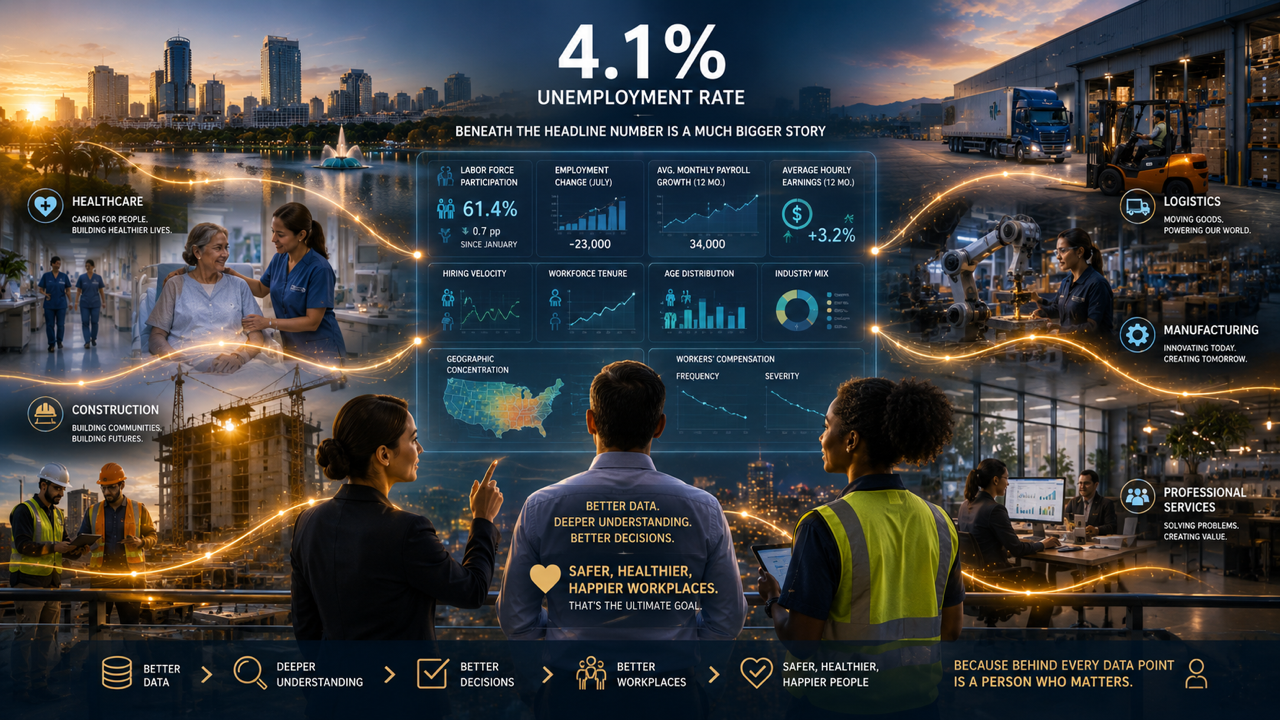
At first glance, the headline number was relatively uneventful. The unemployment rate was 4.1%. But beneath that number, the labor market told a considerably more complicated story.
Nonfarm payroll employment declined by 23,000 jobs in July. Employment estimates for May and June were revised downward by a combined 103,000 jobs. Labor-force participation stood at 61.4% and has declined 0.7 percentage point since January. Meanwhile, payroll growth over the preceding twelve months averaged only 34,000 jobs per month.
Those numbers suggest a labor market that is clearly cooling.
But they also arrive at an interesting moment.
In my last PEO Compass article, The Workforce Is Changing. Workers’ Compensation Is Changing With It, I explored the demographic forces highlighted by NCCI Senior Economist Patrick Coate, Ph.D. at NCCI’s 2026 Annual Insights Symposium.
Population growth is slowing. The workforce is aging.
Workers age 65 and older represent one of the fastest-growing segments of the labor force.
Natural population growth is projected to eventually turn negative.
And the ability of the United States to continually add workers to its economy is becoming increasingly constrained.
The July employment report does not change that story.
If anything, it gives us another way to look at it.
Because unemployment and labor availability are not the same thing.
---
4.1% Does Not Tell the Whole Story
The unemployment rate is an enormously important economic indicator.
But it measures something relatively specific: the percentage of people participating in the labor force who are unemployed and actively looking for work.
It does not tell us how many people are participating in the labor force in the first place.
That distinction becomes increasingly important in an aging population.
According to BLS, labor-force participation was 61.4% in July, down 0.7 percentage point since January. Another 5.9 million people were outside the labor force but reported that they wanted a job.
Those numbers exist alongside the longer-term demographic forces NCCI discussed at AIS.
Slower population growth.
Lower birth rates.
An aging population.
Retirements.
Migration.
Immigration.
Changing participation patterns.
Together, these factors influence something broader than unemployment.
They influence the available supply of labor.
And for employers, PEOs, insurers, and workers’ compensation professionals, that distinction matters.
---
The Workforce Is Not Simply Getting Older. Its Growth Is Becoming Harder to Sustain.
One of my favorite observations from Patrick Coate’s AIS presentation was deceptively simple:
As the labor force evolves, workplace risk evolves with it.
The July employment report adds another dimension to that idea.
The short-term labor market appears to be weakening at precisely the same time longer-term demographic trends are making labor-force growth more difficult to sustain.
Those forces are not contradictory.
They are operating on different timelines.
Economic cycles influence how many workers employers need today.
Demographics influence how many workers may be available tomorrow.
Understanding the workforce requires paying attention to both.
---
Could Slower Hiring Actually Improve Some Workers’ Compensation Outcomes?
A cooling labor market is not necessarily negative from every workers’ compensation perspective.
Earlier in this series, I explored hiring velocity and workforce stability as potential workers’ compensation variables.
Rapid hiring can create operational pressure.
Large numbers of new employees require onboarding and training. Supervisors may suddenly be responsible for more inexperienced workers. Institutional knowledge becomes diluted across a rapidly expanding workforce. Employees unfamiliar with their jobs may still be developing hazard recognition, muscle memory, and familiarity with organizational procedures.
If hiring slows, some of those pressures may ease.
Average tenure may increase.
Turnover may decline.
Training resources may become less strained.
Supervisors may have more time to develop employees.
Workforce stability may improve.
Those conditions could potentially contribute to improved workers’ compensation outcomes.
Could.
That distinction is important.
As discussed throughout this series, additional information creates hypotheses worth studying—not conclusions we should assume.
The interaction between hiring velocity, tenure, demographics, and loss experience will differ considerably by employer and industry.
A cooling labor market does not necessarily mean labor is abundant.
One describes current demand for workers. The other describes the longer-term supply of workers available to meet that demand. Both can exist at the same time.
---
But Labor Scarcity Creates Different Risks
There is another side to the equation.
Employers do not simply stop operating because qualified workers become more difficult to find.
They adapt.
They may retain experienced employees longer.
They may increase overtime among existing employees.
They may accelerate the development of less experienced workers.
They may modify job requirements.
They may invest in automation.
They may redesign jobs.
They may recruit workers from different geographic markets.
Each response changes the workforce differently.
And each potentially changes workers’ compensation risk differently.
An experienced employee remaining in a physically demanding position longer may present different ergonomic considerations.
An employee working additional overtime may experience different fatigue exposures.
A newly hired employee entering a skilled occupation may require additional training and supervision.
Automation may eliminate one physical exposure while creating an entirely different interaction between employees and equipment.
Once again, demographics do not determine risk.
They provide context for understanding how work is changing.
---
Where Employment Changes Matters
The July employment report also demonstrates why national employment numbers require additional context.
Employment changes were not distributed evenly across the economy.
Local government education lost approximately 50,000 jobs in July.
Retail trade lost approximately 19,000.
Financial activities declined by approximately 14,000, including roughly 7,000 jobs among insurance carriers and related activities.
Healthcare, meanwhile, added approximately 22,000 jobs, although that was below its average monthly gain of roughly 36,000 over the preceding twelve months.
Employment in construction, manufacturing, transportation and warehousing, professional and business services, and several other major industries changed relatively little.
For workers’ compensation, these distinctions matter enormously.
Twenty thousand additional healthcare employees do not create the same exposures as twenty thousand additional construction workers.
A decline in retail employment does not have the same implications as a decline in manufacturing.
Employment growth changes payroll.
But it also changes class-code distribution, occupational exposures, employee demographics, training requirements, geographic concentration, and ultimately the composition of workers’ compensation risk.
The national unemployment rate cannot tell us that story by itself.
There is another interesting number buried within the July report.
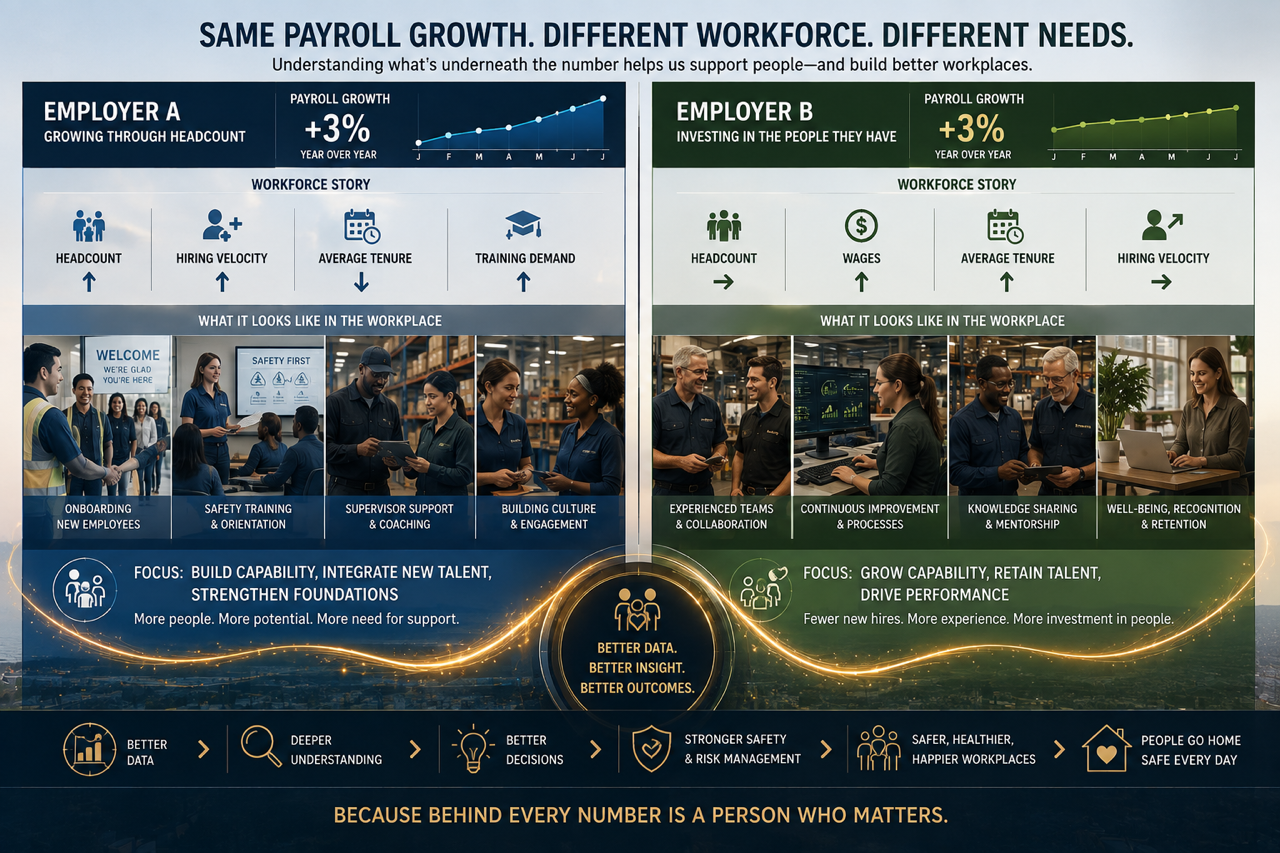
Average hourly earnings increased approximately 3.2% over the preceding twelve months.
That creates an important workers’ compensation distinction.
Payroll can increase even when headcount does not.
Imagine two employers.
Both report 3% payroll growth.
Employer A increased payroll because it hired additional employees.
Employer B employs essentially the same number of people but increased wages.
From a traditional payroll perspective, those organizations may initially appear to be moving in similar directions.
Operationally, they may be doing something entirely different.
Employer A may be experiencing higher hiring velocity, declining average tenure, increased onboarding demands, and greater supervisory pressure.
Employer B may have a more stable and experienced workforce whose compensation has simply increased.
The payroll is important in both cases.
But the workforce characteristics underneath the payroll help explain what that number actually represents.
This is precisely why richer workforce data creates such interesting opportunities for workers’ compensation underwriting.
It does not necessarily replace the variables we already use.
It adds context around them.
---
Fewer Workers Make Productivity More Important
There are ultimately two broad ways to grow an economy.
Add more workers.
Or produce more with the workers we already have.
If demographic forces constrain labor-force growth over time, the second becomes increasingly important.
That means productivity.
And increasingly, it means technology.
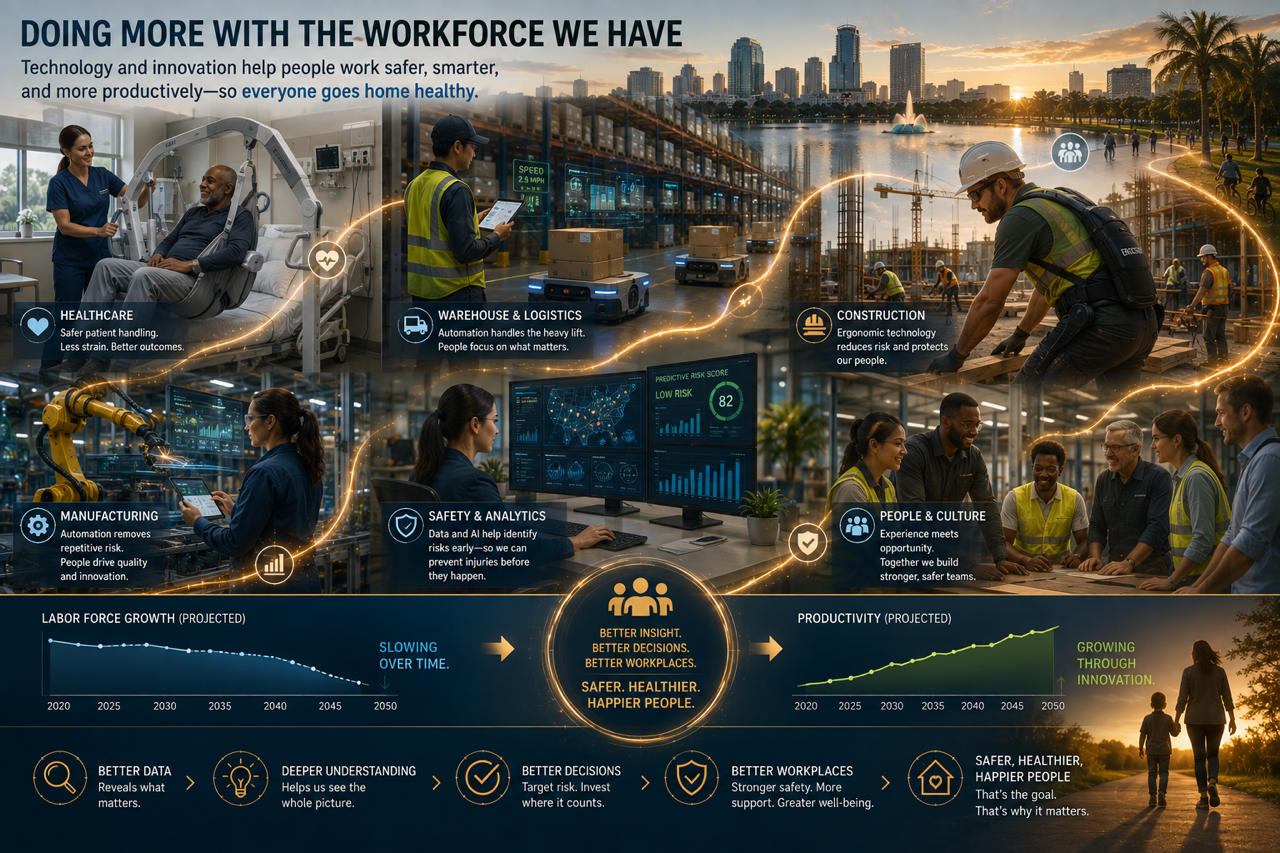
Automation, artificial intelligence, robotics, wearable safety technology, ergonomic equipment, and increasingly sophisticated data analytics are often discussed primarily as cost-saving tools.
But in an environment where labor itself becomes more difficult to expand, these technologies may serve another purpose.
They can increase the productive capacity of the existing workforce.
That creates another fascinating workers’ compensation question.
What happens to workplace risk when technology changes the physical work humans actually perform?
A mechanical lifting device may reduce overexertion injuries.
Automation may remove employees from repetitive or dangerous tasks.
Predictive analytics may identify safety concerns earlier.
Artificial intelligence may improve training, scheduling, or hazard identification.
At the same time, new technologies introduce new workflows, new equipment, and new interactions requiring their own training and risk management.
Technology changes work.
And when work changes, workers’ compensation eventually changes with it.
The PEO Advantage
This is where the PEO industry occupies an especially interesting position.
A PEO may observe workforce changes across hundreds or thousands of small and midsized employers.
Employee counts.
Payroll.
Wages.
Hiring velocity.
Turnover.
Tenure.
Industry.
Geography.
Demographics.
Claims.
Individually, each represents a piece of information.
Together, they may tell a much richer story about how an organization, and even an ecosystem, is changing.
And because PEOs can observe those characteristics across large populations of employers, they may eventually be able to distinguish isolated organization behavior from broader workforce patterns.
PEOs also possess another potential advantage: scale.
Many small and midsized businesses may not have the resources, expertise, purchasing power, or internal infrastructure to independently evaluate and implement emerging safety technologies. A PEO can help bridge that gap.
Wearable safety devices, ergonomic technologies, AI-assisted training, telematics, predictive safety analytics, and other emerging tools can be evaluated at the PEO level and potentially deployed across large populations of clients. That creates an opportunity to bring sophisticated loss prevention resources to businesses that might otherwise never have practical access to them.
Scale also creates a new opportunity to learn.
When new safety technologies are implemented across a broad population, PEOs may be uniquely positioned to observe where they work, where they do not, and which workforce or operational characteristics influence their effectiveness. Those lessons can then inform future loss prevention strategies across the broader client population.
A national unemployment rate can tell us something important about the American economy.
A PEO’s workforce data may tell us something much more specific about the employers actually generating workers’ compensation exposure.
That’s valuable insight.
---
Cooling Is Not the Same as Reversing
The July employment report suggests that the labor market is cooling.
That deserves attention.
But a cooling labor market does not reverse the demographic forces reshaping the American workforce.
Population growth remains slow.
The population continues to age.
Experienced workers continue to retire.
Labor-force participation continues to matter.
Employers continue to compete for skilled workers.
And technology continues to change how work is performed.
The economic cycle and the demographic cycle are occurring simultaneously.
Understanding workers’ compensation risk increasingly requires understanding both.
Monthly employment reports tell us how the labor market is moving.
Demographics help explain the boundaries within which it can move.
And increasingly rich workforce information can help employers, PEOs, carriers, actuaries, and risk professionals better understand what is happening where those forces meet.
But understanding risk is not the ultimate objective.
Neither is building a better predictive model.
Nor is identifying the next underwriting variable.
Those are tools.
The real opportunity is what we can do with what we learn.
Better information can help identify where employees need additional training.
Better analytics can help recognize emerging risks before they become injuries.
Technology can reduce physical demands, eliminate repetitive tasks, and help people perform difficult jobs more safely.
Better workforce data can help employers understand the needs of the people doing the work, and organizations such as PEOs can help bring those capabilities to thousands of small and midsized businesses that may not otherwise have access to them.
That is where all of these conversations ultimately converge.
A safer workplace.
A healthier workforce.
Employees who feel supported, valued, and equipped to succeed.
People who can build careers, provide for their families, find satisfaction in meaningful work, and go home safely at the end of the day.
That is the 30,000-foot view.
The labor market will expand and contract.
Demographics will change.
Technology will advance.
The way we work will continue to evolve.
Fortunately, our ability to understand those changes—and use that understanding to improve the workplace—continues to evolve as well.
As the labor force evolves, workplace risk evolves with it.
Our responsibility is to make sure our response evolves too.
Because better data and better underwriting are valuable.
But safer, healthier, happier workplaces are the goal.