Safety and Training Indicators: What Happens Before the Injury Matters
Reni Snider, Senior Account Executive, Libertate Insurance

A completed training roster tells us who attended.
It does not necessarily tell us who understood the material, who can apply it safely, or whether the workplace hazards discussed during training were ever corrected.
Workers’ compensation underwriting has long examined the consequences of workplace injuries through loss experience, claim frequency, severity and development. Those measures remain foundational. But operational data creates an opportunity to examine something earlier: how an organization prepares employees, identifies hazards and follows through on prevention.
Could those characteristics help us better understand tomorrow’s risk?
That is a question worth investigating.
Prevention Still Matters
The Bureau of Labor Statistics reports that private industry employers recorded approximately 2.5 million nonfatal workplace injuries and illnesses in 2024. The total recordable incidence rate declined from 2.4 to 2.3 cases per 100 full-time-equivalent workers.
Those figures reflect progress, but context matters. The decline in total cases was driven by fewer illnesses, particularly respiratory illnesses. It cannot simply be attributed to better safety programs or more effective training. These figures also measure employer-reported workplace injuries and illnesses, rather than workers’ compensation claims.
Nevertheless, the scale of workplace harm reinforces the value of understanding what employers do before an injury occurs.
Our previous installment considered how an employer’s response after injury can influence recovery and claim outcomes. Safety and training indicators bring that same organizational perspective into prevention.
From Historical Outcomes to Present Capabilities
Loss runs describe what has happened.
Safety records can help describe what an organization is doing now.
OSHA distinguishes between lagging indicators, such as injury rates and claim costs, and leading indicators, such as hazard identification, training completion and timely corrective actions. It recommends using both to evaluate safety performance.
For workers’ compensation, that combination raises useful questions.
Has an employer maintained favorable loss experience because its prevention practices are consistently effective? Have exposures changed since those results were produced? Are training and supervisory resources keeping pace?
Historical performance provides essential evidence. Understanding the organization producing that performance may provide additional context.
However, calling something a leading indicator does not automatically establish that it predicts future claims. Its usefulness in managing safety and its value in an actuarial model are related questions that require different evidence.
Training Completion Is a Starting Point
Training completion is relatively easy to count.
Training effectiveness requires a closer look.
Did employees receive instruction before encountering the relevant hazard? Was it specific to their responsibilities? Could they understand the language and demonstrate the required skills? Does their supervisor reinforce those practices when production demands increase?
An employer might report excellent completion rates while employees continue working around unresolved hazards. Another might document fewer training hours but combine focused instruction with practical evaluations, consistent supervision and effective controls.
Those differences deserve investigation.
A 2010 NIOSH systematic review found that occupational safety and health training positively affected workers’ safety practices. However, it found insufficient high-quality evidence to establish that training alone reduced injuries or illness.
That finding supports a more thoughtful approach to measurement. Attendance records document participation. Competency checks and workplace observations offer additional evidence about what employees learned and how they apply it.
What Happens After a Hazard Is Identified?
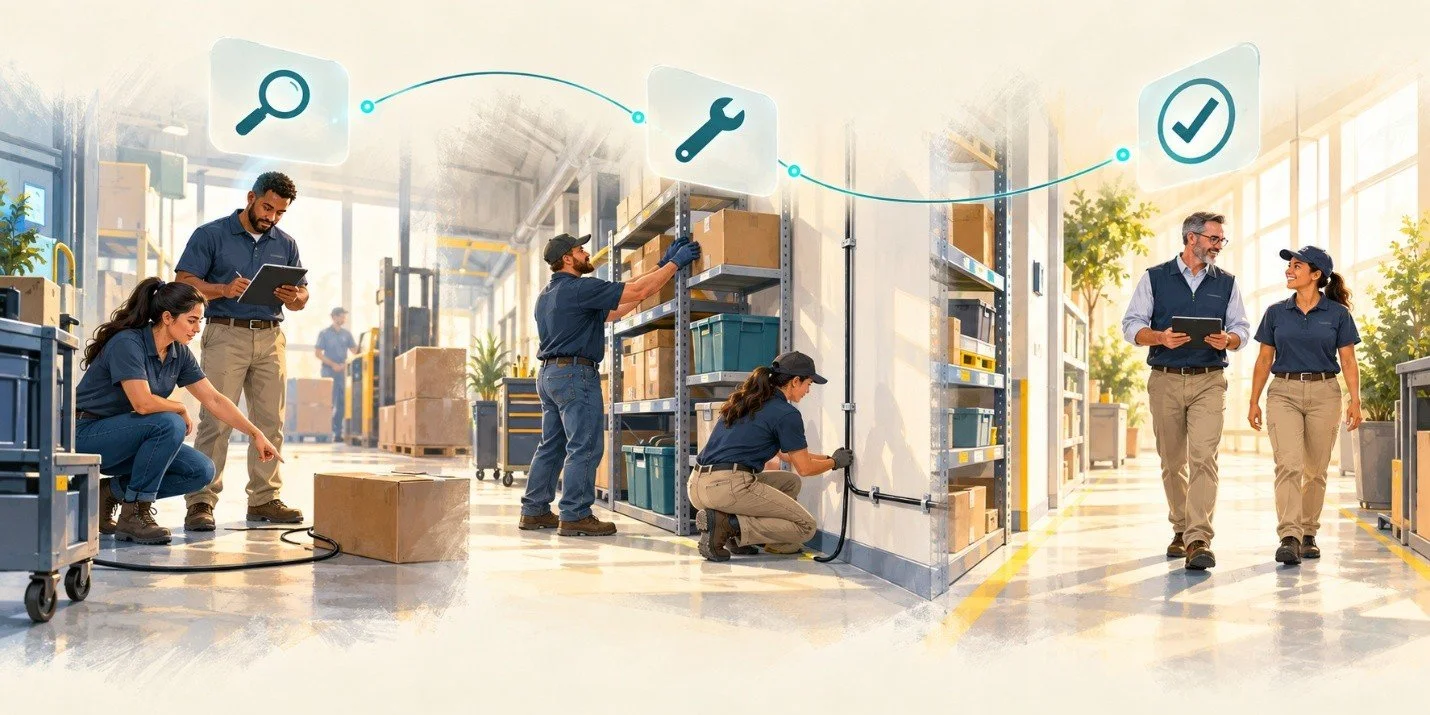
Recognizing a hazard is valuable.
Correcting it is where recognition becomes protection.
NIOSH’s hierarchy of controls prioritizes eliminating hazards, substituting safer alternatives and implementing engineering controls ahead of administrative controls and personal protective equipment. Training supports prevention, but it cannot substitute for every physical or operational improvement.
Teaching safe lifting practices and providing a mechanical lifting aid represent different interventions. A useful assessment considers both employee preparation and the conditions in which employees work.
Potential measures include:
Required task-specific training completed before work begins.
Time from hiring or reassignment to demonstrated competency.
Overdue corrective actions involving high-priority hazards.
Time between hazard identification and verified correction.
Recurring findings after a corrective action was marked complete.
Preventive maintenance completed on schedule.
OSHA includes training, response times, corrective actions and preventive maintenance among its recommended program-evaluation measures.
Together, these measures begin describing follow-through—an organizational capability that a written safety manual alone cannot demonstrate.
More Reporting Does Not Always Mean More Risk
Safety data also requires careful interpretation.
An increase in reported near misses could reflect deteriorating conditions. It could also reflect employees becoming more comfortable speaking up.
Similarly, zero reported hazards might describe a well-controlled workplace—or one where concerns rarely reach management.
The count alone cannot resolve that distinction.
An organization’s response provides additional context. Are reports acknowledged promptly? Are serious hazards prioritized? Are corrections verified? Do the same problems return?
A reporting system becomes more useful when employees see that raising a concern produces meaningful action. Measurements should support that process without creating pressure to keep reported numbers artificially low.
The Science Has Not Changed
As explored earlier in this series, “The science itself hasn’t changed. The laboratory has.”
Learning management systems, HR platforms, safety applications and claims systems now make more operational evidence available. Analytical tools allow researchers to explore relationships that were previously difficult to investigate.
None of that guarantees predictive value.
Safety and training indicators should enter the discussion as hypotheses. Do they improve prediction beyond information already captured by industry, classification, workforce tenure and historical losses? Do those relationships remain meaningful across comparable employers when other relevant variables are considered?
Credible analysis requires consistent definitions, appropriate exposure measures and safety information recorded before the outcomes being predicted.
The most informative relationships may also involve several variables together. Rapid hiring, delayed task training and limited supervisory capacity could reveal something that each measure independently misses.
That possibility connects directly to our earlier discussions of workforce stability and hiring velocity. Prevention capability must evolve alongside the workforce it supports.
Where PEOs Can Add Value
Where services and data access permit, PEOs can help connect workforce changes, training records, safety findings and claims at the client-company level.
That visibility can support practical action: identifying onboarding gaps, prioritizing unresolved hazards and recognizing recurring injury patterns across similar operations.
The distinction between providing resources and implementing them remains important. A PEO may deliver training and recommendations; the client’s daily execution determines how those resources translate into workplace practices.
Documenting both creates a more credible picture for employers, advisors and underwriters. While it does not guarantee a pricing adjustment, it provides a stronger foundation for understanding risk.
The immediate value is clear even while predictive relationships remain under investigation. Preparing employees, controlling hazards and following through on concerns can strengthen the workplace today. Actuarial science can then examine whether evidence of those capabilities also helps reduce uncertainty about tomorrow.
Building Workplaces Worth Building a Future In
The value of that work extends beyond workers’ compensation.
Building better jobs in America is something we owe ourselves and future generations. Doing it well requires thoughtful preparation, investment and accountability—the same qualities that support effective workplace safety.

The ambition should extend beyond increasing headcount and filling positions. It should include creating well-paying jobs in safe, healthy workplaces where employees feel respected, supported and proud of what they do. Jobs people are happy to go to each day. Jobs that allow families to live comfortably, put down roots and build their futures in the communities they love.
Small and medium-sized businesses across the country have an essential role in that vision. PEOs are uniquely positioned to help them pursue it.
Through their work across human resources, payroll, benefits, risk management and workplace safety, PEOs strive to perfect the art of employment. They help business owners translate the ambition to be a good employer into the systems, practices and support that make it possible.
Helping a business grow responsibly means helping it prepare new employees, support supervisors, control hazards and build a workplace worth staying in.
That is the larger promise of the PEO relationship: helping businesses succeed while making employment better for the people whose work makes that success possible.
Better data can help us understand risk. Thoughtful action can help us reduce it. Together, they can support stronger businesses, safer and happier workplaces, and a future American families can be proud to build.