
Return-to-Work Performance: What Happens After the Injury Matters
Reni Snider, Senior Account Executive, Libertate Insurance

Consider two employees with remarkably similar injuries. Similar occupations, similar wages, similar diagnoses and similar initial medical treatment. One returns to modified duty within two weeks. The other remains out of work for two months.
By the time those claims close, they may bear little financial resemblance to one another.
The injury matters. But so does everything that happens afterward.
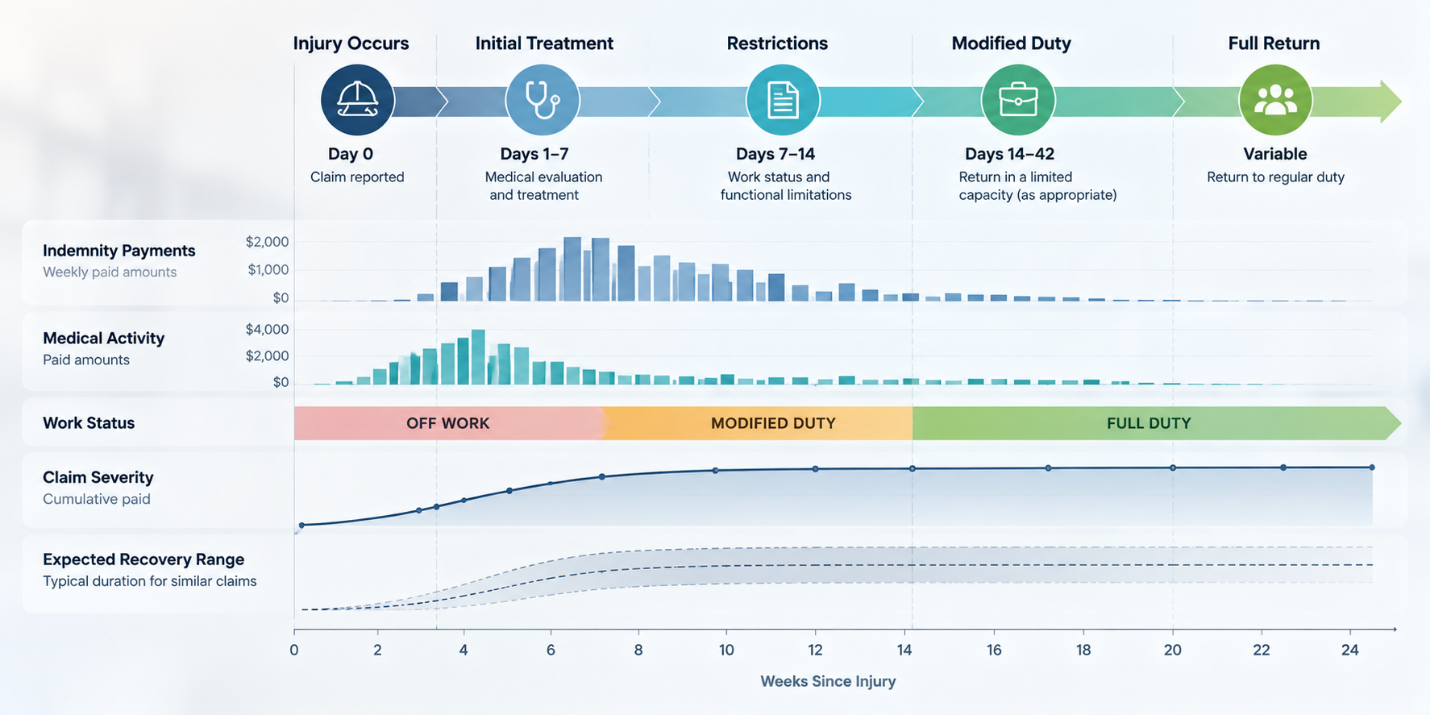
We have already considered claims not simply as numbers, but as trajectories. Return-to-work performance gives us an opportunity to look more closely at what can influence that trajectory.
Frequency Is Falling. Severity Is Not.
Workers' compensation has experienced a long-term decline in claim frequency. That trend continued in 2024.
NCCI reports that countrywide lost-time claim frequency declined 5.9% in 2024. At the same time, however, indemnity severity increased 4.9% and medical severity increased 6.3%.
Fewer claims are occurring. The claims that do occur are becoming more expensive.
The Workers Compensation Research Institute's 2026 CompScope Benchmarks offers another perspective. Across 18 states, total workers' compensation claim costs grew an average of 6% per year from 2022 through 2025 in the median study state. WCRI attributes that increase to growth across the major components of a claim: medical payments, indemnity benefits and benefit delivery expenses. Importantly for this discussion, WCRI specifically identifies longer durations of temporary disability as one source of upward pressure on indemnity benefits.
The analysis covers claims involving more than seven days of lost time, evaluated at 12 months of experience. In Florida, total payments per claim increased approximately 5% annually from 2022 through 2025, with growth in indemnity benefits accounting for the largest share of the increase.
These are different datasets measuring different things, but together they highlight an important challenge.
If fewer injuries are producing lost-time claims, continued improvement in workers' compensation performance cannot depend solely upon preventing the next injury. We also have to become better at managing the claims that do occur.
Return-to-work belongs squarely in that conversation.
Measuring the Cost of Time
Indemnity severity is influenced by wages, statutory benefit structures, injury severity, permanent impairment, litigation and numerous other factors. But duration matters too.
Every additional week an injured employee remains away from work can mean another week of wage-replacement benefits. More importantly, prolonged disability can change the trajectory of a claim.
That makes return-to-work performance potentially measurable in ways that go considerably beyond whether an employer has a written light-duty policy.
The most direct question may also be the most useful: how long are injured employees remaining away from work?
Even that question can be examined from several angles. How much time passes between the injury and the employee's first return in any capacity? How often is modified duty used? How long does an employee remain on modified duty before returning to full duty? How much time passes between a physician releasing an employee to work and the employee actually returning? How frequently does an employee return to work only to leave again?
Those intervals represent more than elapsed calendar time. They capture pieces of the recovery process—and potentially pieces of the employer's response to it.
A PEO could examine average disability duration, percentage of claims converting from medical-only to lost-time, time from medical release to actual return, modified-duty utilization, recurrent periods of disability and claim closure patterns. Those measures can then be segmented by injury type, class code, wage band, jurisdiction, client population or other relevant characteristics.
Distinction is important. A construction worker recovering from a shoulder injury and an office employee recovering from the same diagnosis may face very different barriers to returning safely to work. Geography, wages, occupation, injury mix and workforce characteristics can all affect the result.
The objective, then, is not to reduce return-to-work performance to a single metric.
It is to examine multiple measures of disability and recovery while accounting for the conditions surrounding them—and determine whether meaningful patterns emerge.
None of those measures tells the story independently.
Together, they begin describing an organizational capability.
Return-to-Work Is an Organizational Capability
An employer cannot prevent every workplace injury.
It can influence what happens next.
How quickly is the injury reported? How quickly does appropriate medical treatment begin? Does the employer maintain meaningful modified-duty opportunities? Does the treating physician understand the physical demands of the employee's regular job—and what alternative work is available? Does the supervisor understand the employee's restrictions? Does someone communicate with the injured employee while he or she is away?
And perhaps most importantly: who owns the process?
Return-to-work can fail in the spaces between people.
The adjuster is waiting for restrictions. The physician does not know modified duty is available. The supervisor does not know what the restrictions mean. Human resources assumes the carrier is handling it. The employee hears very little from the workplace.
Days become weeks.
That passage of time has a cost.
It also has a human consequence.
Work Can Be Part of Recovery
Return-to-work should never mean pushing an injured employee back into a job before it is medically appropriate.
Good return-to-work is almost the opposite. It asks what an employee can safely do while recovering and whether meaningful work can be structured around those capabilities.
That distinction matters for reasons extending beyond workers' compensation costs.
Employment provides income, certainly, but work can also provide routine, social connection, identity, accomplishment and purpose. There is scientific evidence that good work can support mental health.
A systematic review of 33 prospective studies found strong evidence of a protective effect of employment on depression and general mental health. Pooled results showed favorable associations with depression and psychological distress. Separate research specifically examining return-to-work has found positive relationships between RTW, workplace autonomy and psychological well-being.
That does not mean every job is good for mental health, nor does it mean returning to work prematurely is beneficial. Workplace quality, appropriate accommodation and good supervision matter.
But it does challenge the idea that return-to-work is fundamentally about reducing indemnity payments.
Done well, it can help preserve income, routine, social connection, professional identity, purpose, mental health and an employee's connection to the workforce.
Safer, happier, healthier workplaces should be the objective.
Lower claim costs can be a consequence of getting that objective right.
Better Instruments Allow Better Questions
Earlier in this series, we discussed the evolution of actuarial science and an important distinction: actuarial science itself has not suddenly changed. Our ability to observe risk has.
The scientific method remains remarkably familiar. Observe. Form a hypothesis. Test it. Validate it. Refine it.
What has changed is the evidence available for that process.
Historically, an underwriter examining two employers might observe that one produces consistently higher indemnity severity. Loss runs establish the outcome. Experience rating eventually reflects portions of it. Actuarial analysis can measure the difference.
But richer datasets allow us to ask the next question:
Why?
Was the difference driven by wages? Injury mix? Geography? Workforce age? Employee tenure? Hiring patterns? Medical utilization? Litigation? Or did employees simply remain away from work longer?
Several of those variables should sound familiar by now.
More importantly, they do not operate independently.
A younger workforce in one geography experiencing rapid hiring and short tenure may behave differently from a stable, experienced workforce somewhere else. An identical return-to-work program may perform differently in construction than it does in professional services. An employer with excellent modified-duty capabilities may still struggle where access to occupational medicine is limited.
That complexity is precisely why richer data matters.
The objective is not to discover a magical new rating variable called "return-to-work."
It is to understand whether return-to-work performance contains meaningful predictive information once the other variables surrounding it are understood.
From Loss Outcome to Operational Signal
This is where workers' compensation data becomes particularly interesting for PEOs.
A PEO may have hundreds or thousands of client companies performing similar work under the same workers' compensation program. That scale creates something an individual small employer rarely possesses: a sufficiently large population from which patterns can emerge.
Consider what could be examined across that population:
Average disability duration by client. Paid indemnity severity on closed claims. Modified-duty utilization. Medical-only to lost-time conversion. Time between physician release and actual return. Closure rates at 12, 24 and 36 months. Outcomes by class code, geography, tenure, wage band or injury type.
Then compare those results.
Perhaps one client consistently returns injured employees to medically appropriate modified duty faster than its peers.
Perhaps another produces unusually long disability durations despite otherwise comparable injuries.
Perhaps certain supervisors, locations or industries consistently outperform others.
Perhaps an employer's indemnity severity improves after implementation of a structured return-to-work program.
Any one observation can be noise.
Repeated patterns across credible populations are something else entirely.
That is where actuarial analysis becomes powerful—not because the model tells us what to think, but because it helps us determine which hypotheses deserve to be tested.

The PEO Advantage
There is another reason return-to-work deserves attention in the PEO environment.
Most small and midsized employers will never employ a dedicated workers' compensation risk manager. They may not have formal job-demand analyses, established transitional-duty programs, sophisticated claims dashboards or dedicated relationships with occupational medicine providers.
A PEO can provide infrastructure that would be difficult for many individual employers to build themselves.
Standardized job-demand templates. Transitional-duty libraries. Supervisor education. Claims escalation protocols. Return-to-work coordinators. Medical-provider communication. TPA performance standards. Analytics identifying claims whose disability duration is beginning to depart from expected patterns.
Scale can turn return-to-work from an informal practice into an organizational system.
And scale provides the data necessary to determine whether that system is working.
This is true whether the workers' compensation program is guaranteed cost, large deductible, captive or another loss-sensitive structure. The financing mechanism determines who feels the financial effect first and how quickly. It does not make poor claim outcomes disappear.
Eventually, the loss experience tells its story.
From Measuring Injury to Measuring Recovery
Workers' compensation has become extraordinarily good at measuring injury.
We measure frequency. Severity. Medical costs. Indemnity costs. Experience modification. Loss development. Ultimate loss.
Increasingly, we can measure recovery too.
How quickly did appropriate treatment begin?
How long was the employee away?
When was modified duty offered?
How long after medical release did the employee actually return?
Which employers consistently bring people safely back into the workplace?
And which claims begin following a different trajectory when they do?
The traditional workers' compensation record tells us what an injury ultimately cost.
A richer dataset can help us understand what happened between the injury and that final number—and which parts of that journey may have been influenced by the employer, the carrier, the PEO and the systems surrounding the injured worker.
That is not replacing traditional actuarial science.
It's giving actuarial science more evidence to work with.
And if we use that evidence well, the objective should be larger than predicting which claims will cost more.
It should help us build workplaces where fewer people are injured, where injured employees recover more successfully, and where people can remain connected to productive work whenever it is medically appropriate.
Safer. Happier. Healthier.
That is a workers' compensation outcome worth predicting—and worth pursuing.