Hiring Velocity: When Organizational Change Becomes a Workers’ Compensation Variable
Reni Snider, Senior Account Executive, Libertate Insurance
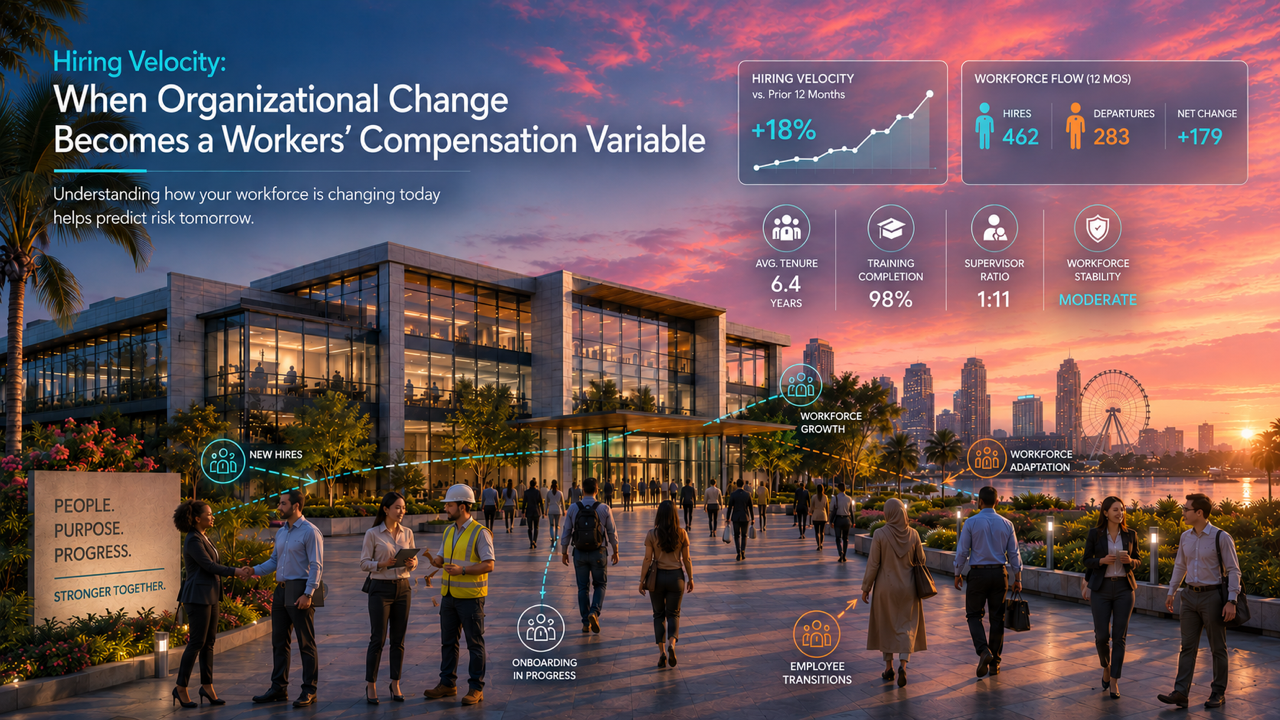
Growth has traditionally been viewed as one of the strongest indicators of a healthy business. New contracts, expanding payrolls, and increasing headcount typically signal opportunity and long-term success.
Conversely, workforce reductions are often viewed as signs of financial distress. While that can certainly be true, reductions can also represent thoughtful strategic decisions intended to improve efficiency, profitability, or long-term competitiveness.
From a workers’ compensation perspective, however, both rapid expansion and rapid contraction represent something much more fundamental: organizational change.
The question is not whether a company is growing or shrinking.
The question is whether the pace of that change influences future workers’ compensation outcomes.
Arguably, the answer is yes.
Looking Beyond Historical Performance
Traditional workers’ compensation underwriting has focused primarily on three variables:
Annualized payroll
Employee classifications
Historical loss experience
Those metrics remain foundational to underwriting today. However, advances in actuarial science, predictive analytics, and workforce technology are allowing underwriters to evaluate organizations through an increasingly dynamic lens.
Rather than asking only what a business has looked like historically, increasingly sophisticated underwriting models are becoming better equipped to ask:
How is this organization changing today?
Hiring velocity is one of several workforce metrics that may help answer that question.
Defining Hiring Velocity
For purposes of this discussion, hiring velocity refers broadly to the rate at which an organization’s workforce is changing over time.
That includes organizations experiencing:
Stable workforce levels
Moderate expansion
Rapid hiring
Hiring freezes
Workforce reductions
Viewed this way, hiring velocity becomes less about measuring growth and more about measuring organizational change.
Neither positive nor negative hiring velocity is inherently good or bad.
Both simply introduce operational challenges that may ultimately influence workers’ compensation outcomes.
This is where the story behind the change matters.
Why Hiring Velocity Matters
Organizational change places additional demands on leadership.
Whether hiring rapidly or reducing staff, organizations must continuously maintain:
Effective onboarding
Employee training
Adequate supervision
Clear communication
Strong safety culture
Operational consistency
The faster an organization changes, the more difficult it becomes to preserve consistency across each of these areas.
That doesn’t mean rapid change inevitably leads to increased claims.
It simply means leadership has more variables to successfully manage.
Positive Hiring Velocity
Rapid hiring often increases the percentage of employees who are still learning the organization.
New employees are becoming familiar with:
Job responsibilities
Equipment
Company procedures
Workplace hazards
Organizational expectations
As employees gain experience, much of that uncertainty naturally declines.
Organizations experiencing rapid growth must therefore ensure that training programs, supervisory capacity, and safety initiatives scale alongside workforce expansion.
This relationship should not come as a surprise. OSHA has reported that approximately 35% of work-related injuries and illnesses occur during an employee’s first year on the job, underscoring the importance of effective onboarding, training, and supervision during periods of workforce expansion.
NIOSH has likewise identified new workers as a higher-risk population, emphasizing that unfamiliarity with job tasks, equipment, workplace hazards, and organizational procedures can all contribute to elevated injury risk during the early stages of employment.
Growth itself isn’t the challenge.
Growing well is.
Negative Hiring Velocity
Workforce reductions introduce a different—but equally important—set of operational considerations.
Remaining employees may be asked to:
Assume unfamiliar responsibilities
Work additional hours
Operate with reduced supervisory support
Maintain production with fewer resources
Adapt to changing organizational structures
If these transitions are not managed intentionally, operational strain can increase while consistency begins to erode.
Again, workforce reductions are not inherently problematic.
Poorly managed organizational change is.
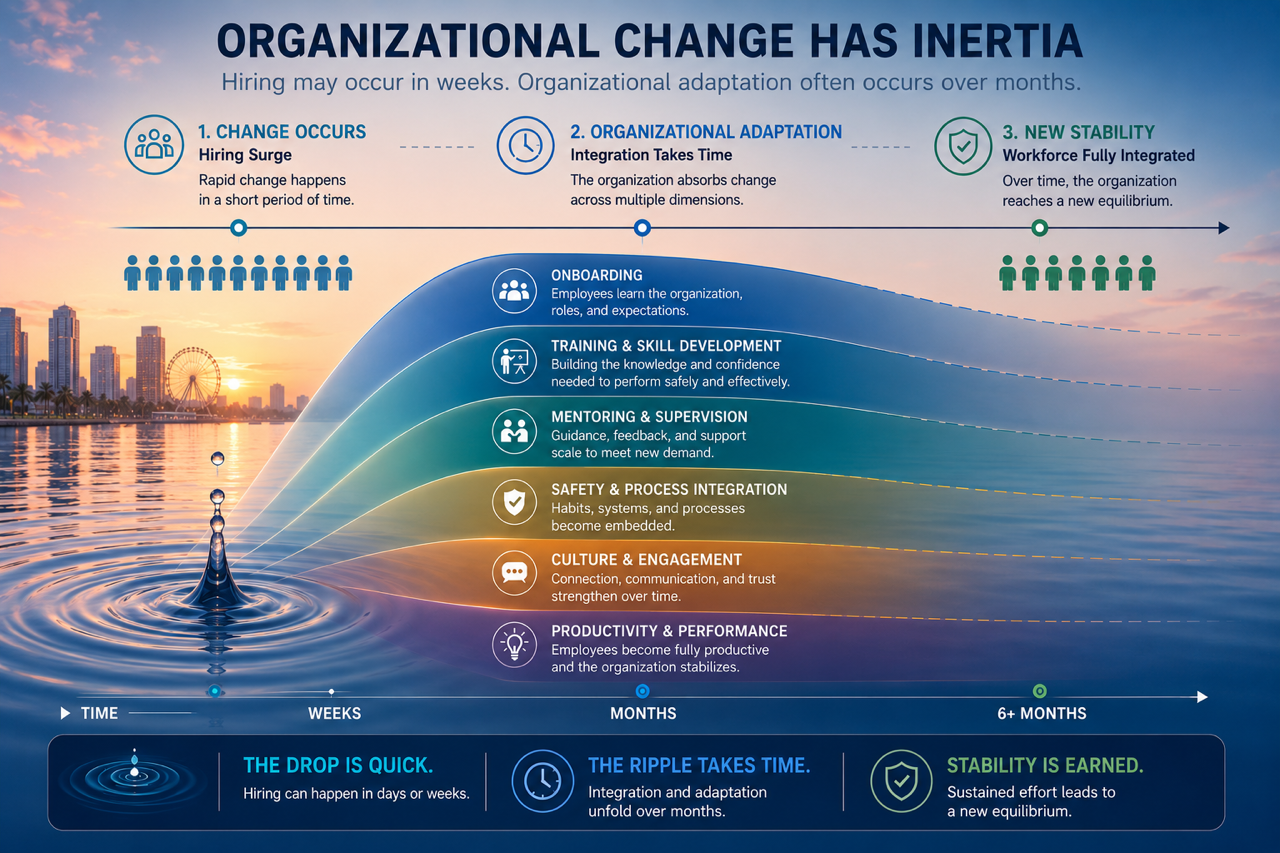
Organizational Change Has Inertia
Hiring velocity measures how quickly an organization changes.
But organizational change also has inertia.
An organization that hires one hundred employees in a single month does not suddenly become stable the following month simply because hiring slows. It may take six months—or longer—for those employees to become fully trained, productive, and culturally integrated.
The same is true following significant workforce reductions.
Operational disruption doesn’t necessarily end when the layoffs are complete. Remaining employees, supervisors, and leadership teams often continue adapting long afterward.
Understanding that period of adjustment may ultimately prove just as valuable as measuring hiring velocity itself.
Supervisory Capacity Matters
One of the most overlooked aspects of organizational growth is leadership capacity.
Organizations don’t simply hire additional frontline employees.
They must also expand the infrastructure that supports them, including:
Supervisors
Trainers
Safety professionals
Human resources
Operational leadership
Likewise, workforce reductions frequently eliminate many of these same support functions.
Whether expanding or contracting, organizations create risk when workforce demands begin outpacing leadership capacity.
Safety Culture Doesn’t Scale Automatically
Strong safety cultures are built deliberately.
They develop through leadership, communication, accountability, and consistent reinforcement.
They do not automatically expand—or survive restructuring—simply because an organization expects them to.
Organizations experiencing significant workforce change must intentionally preserve their safety culture from executive leadership through frontline supervision.
Culture requires maintenance.
Especially during periods of change.
The Labor Market Is Changing
Hiring velocity should also be interpreted within the broader context of today’s labor market.
Employers are simultaneously navigating:
An aging workforce
Lower birth rates
Persistent labor shortages across many industries
Shifting immigration policy
Increased competition for skilled labor
The growing integration of artificial intelligence into the workplace, creating new opportunities while fundamentally changing others
Collectively, these forces influence both the size and composition of the available labor pool.
In many industries and geographic regions, employers may increasingly find themselves hiring from a smaller, less experienced, or differently skilled workforce than in previous decades.
That makes effective recruiting, onboarding, training, supervision, and retention increasingly important.
Better Data Creates Better Context
Much of the workforce data needed to understand these trends has existed for years.
What has changed is its availability, centralization, and our ability to analyze relationships across multiple datasets.
Modern HRIS, payroll, workforce management, and safety platforms increasingly provide a more complete picture of how organizations evolve over time.
As Workday notes, today’s HR platforms increasingly centralize recruiting, payroll, onboarding, training, performance management, and workforce analytics into a unified ecosystem. That level of integration allows organizations—and eventually underwriters—to better understand not only the composition of a workforce, but how it is changing over time.
As these systems continue to mature, they make it possible to evaluate metrics such as:
Hiring rates
Headcount growth
Hiring-to-separation ratios
Percentage of recently hired employees
Average workforce tenure
Supervisor-to-employee ratios
Onboarding completion
Safety training completion
Overtime utilization
Internal promotion rates
Individually, each metric provides useful information.
Collectively, they begin telling the story of how an organization is changing.
Growth Isn’t the Risk
Neither is decline.
Organizational change itself is not inherently favorable or unfavorable.
Many rapidly growing organizations maintain exceptional safety performance.
Likewise, many organizations successfully navigate workforce reductions without experiencing increased workers’ compensation claims.
The differentiator is often whether operational infrastructure evolves alongside organizational change.
The focus should be on preparedness and execution—not workforce size alone.
A Simple Example
Consider three organizations with nearly identical historical loss experience.
Company A has maintained a stable workforce with modest hiring and long-tenured supervisors.
Company B has doubled its workforce over the past twelve months.
Company C has reduced its workforce by thirty percent while asking remaining employees to absorb additional responsibilities.
Their historical loss runs may appear remarkably similar.
Their future operational risk profiles almost certainly do not.
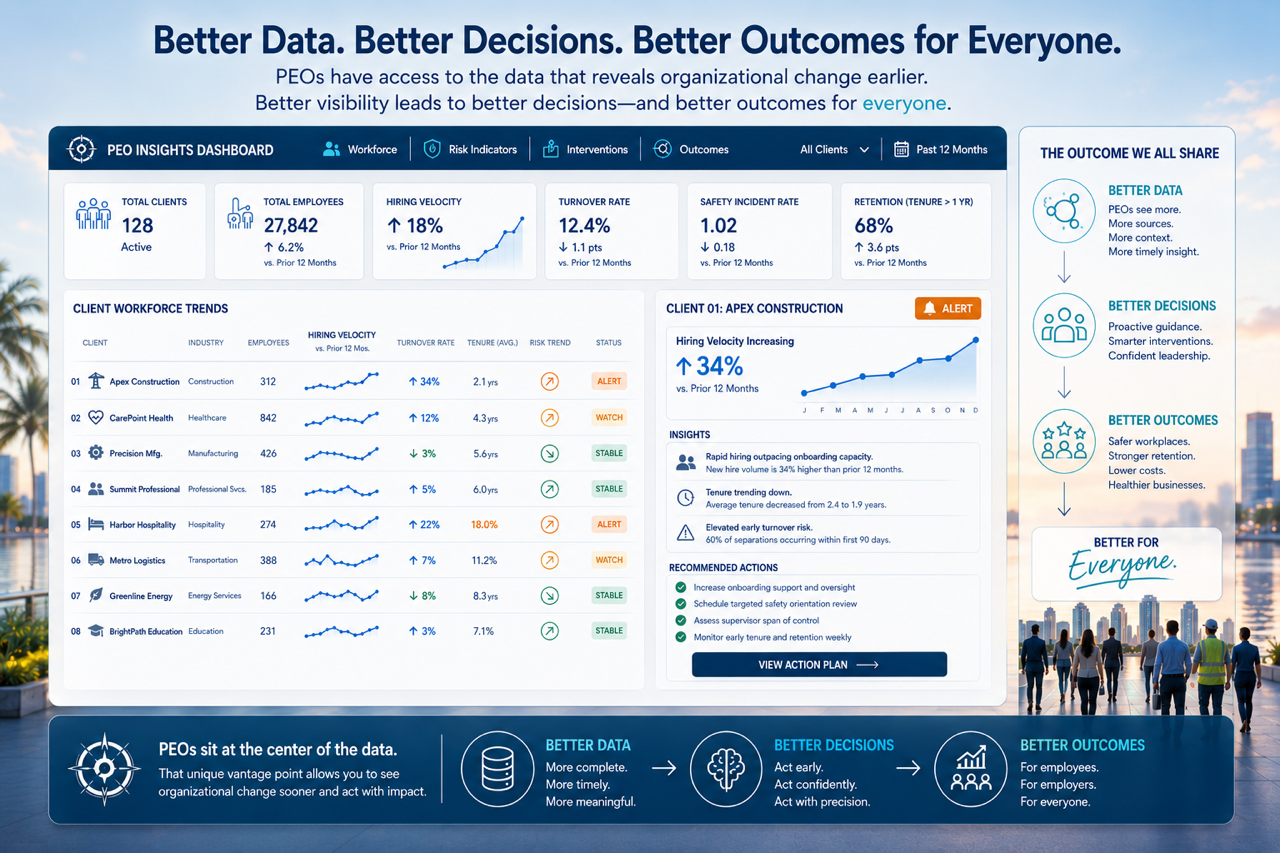
The PEO Advantage
This is where Professional Employer Organizations are uniquely positioned.
PEOs observe workforce trends across diverse industries, geographic regions, and employer sizes. Through the co-employment relationship, they often recognize meaningful changes in hiring activity and workforce composition as they occur.
That visibility creates opportunities to proactively help clients:
Strengthen onboarding
Reinforce safety training
Monitor workforce trends
Scale supervisory resources
Identify periods of elevated organizational risk before losses emerge
When implemented effectively, the co-employment relationship creates mutual value by helping clients successfully navigate organizational change before it manifests as increased workers’ compensation claims.
One Variable in a Larger Story
Hiring velocity should never be evaluated in isolation.
It represents one variable within a much broader organizational narrative.
Meaningful interpretation requires considering it alongside other indicators such as workforce tenure, turnover, employee demographics, geographic concentration, operational complexity, overtime utilization, return-to-work performance, and historical claims experience.
Otherwise, we’re simply reading numbers rather than understanding the story those numbers are telling.
Looking Ahead
Workers’ compensation underwriting is increasingly focused on understanding organizational change rather than simply organizational history.
Hiring velocity provides another lens through which underwriters can better anticipate future operational risk.
As workforce data becomes more centralized, more accessible, and more interconnected, organizations that successfully manage change—whether growing, contracting, or maintaining stability—may increasingly distinguish themselves from organizations that simply experience change.
For Professional Employer Organizations, this evolution presents a unique opportunity.
Because of their deep integration with payroll, human resources, benefits administration, safety programs, and workforce management, PEOs often have access to richer, more timely workforce data than has historically been available to underwriters. More importantly, they possess the operational context needed to interpret what that data actually means.
That is where the future of workers’ compensation underwriting becomes particularly exciting.
Better data leads to better insight.
Better insight leads to better decisions.
Better decisions lead to better outcomes.
For underwriters.
For insurance carriers.
For client companies.
For employees.
And ultimately, for an industry whose greatest success is measured not by how effectively it responds to workplace injuries, but by how successfully it helps prevent them in the first place.