
Workforce Stability: An Overlooked Driver of Workers’ Compensation Performance
Reni Snider, Senior Account Executive, Libertate Insurance
Employee turnover is a considerable driver of workers’ compensation performance—one that is often overlooked.
Workers’ compensation professionals spend a great deal of time evaluating industries, payroll, classifications, and historical loss performance.
Increasingly, they should also be evaluating workforce stability.
Why?
Research consistently shows that workplace injury risk is highest during the earliest stages of employment.
A 2022 Travelers analysis of more than 1.5 million workers’ compensation claims found that more than one-third of workplace injuries occur during an employee’s first year on the job and account for more than one-third of claim costs. Other research has shown that employees in their first month of employment experience injury rates several times higher than workers with more than a year of tenure.
These findings follow logic. Learning a new job is, by its very nature, a period of elevated risk.
Experience Matters
A newly hired employee is simultaneously learning:
Job responsibilities
Equipment operation
Workplace procedures
Safety expectations
Organizational culture
Communication channels
Even highly capable employees require time to develop familiarity, judgment, and routine.
As tenure increases, employees generally become more efficient, more productive, and better able to recognize and avoid hazards before they become injuries. That relationship helps explain why employee turnover and injury frequency are often closely connected.
High turnover means a larger percentage of the workforce is continuously operating within the highest-risk portion of the employment lifecycle.
The Hidden Cost of Constant Hiring
Organizations often evaluate turnover through the lens of:
Recruiting costs
Training expenses
Productivity disruption
Institutional knowledge loss
Those costs are real.
Additionally, turnover can create an ongoing safety challenge.
Every new hire requires:
Orientation
Safety training
Skill development
Supervision
Reinforcement of safe work practices
When hiring activity remains elevated, organizations may find themselves perpetually onboarding a significant portion of their workforce.
In effect, the workforce never fully matures.
Time-to-Proficiency Matters
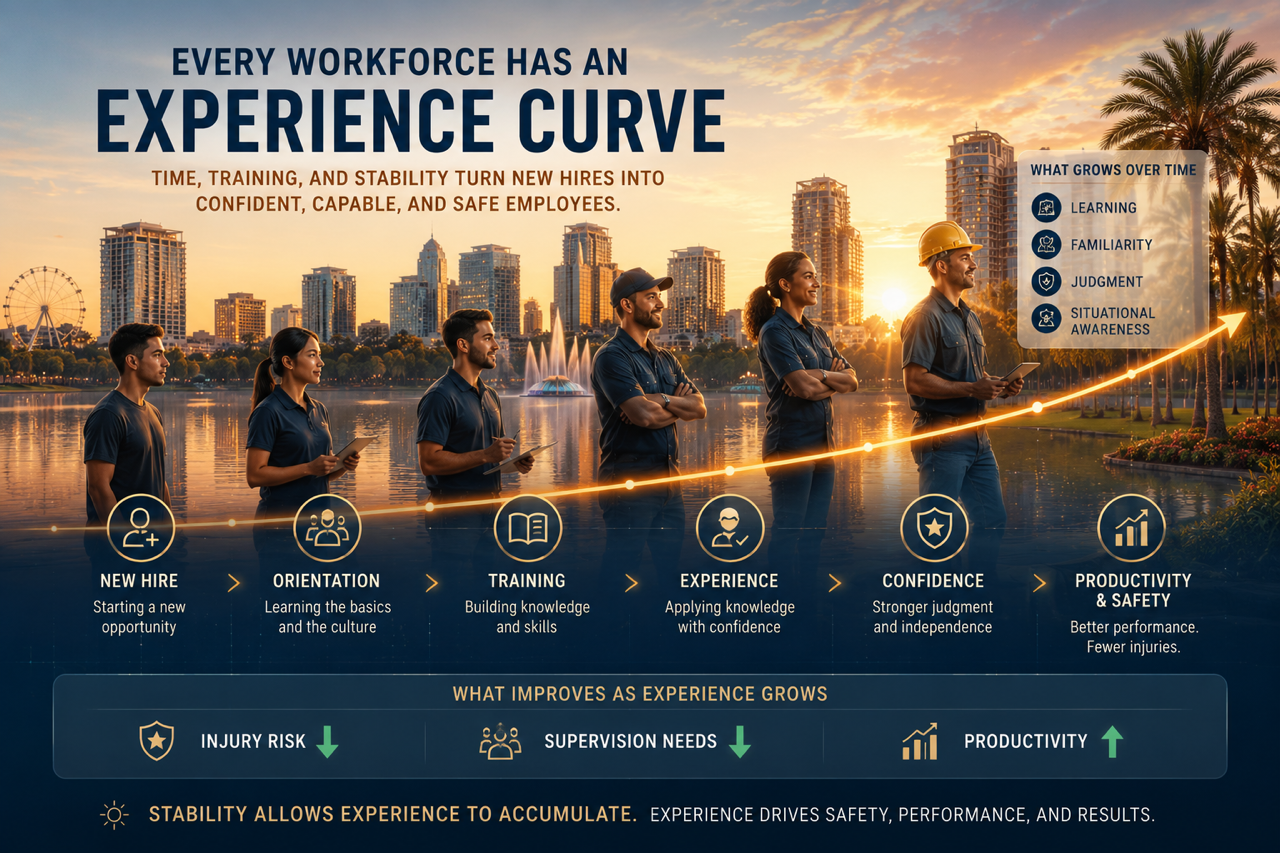
Every position has a learning curve.
Some employees become proficient within weeks. Others require months—or even years—to fully develop the technical skills, situational awareness, and decision-making ability necessary to perform at the highest level.
Organizations with strong employee retention benefit from continually accumulating experience throughout their workforce. Conversely, organizations with persistent turnover repeatedly reset that experience curve.
When a significant percentage of employees are still learning the job, a larger share of the workforce may be operating before reaching full proficiency.
That dynamic rarely appears on a financial statement, yet it may influence injury frequency, productivity, quality, and ultimately workers’ compensation performance.
Claims Often Reveal Workforce Maturity
Loss runs tell us what happened.
Increasingly, employers, underwriters, and actuaries are garnering why it happened.
One emerging area of interest is the relationship between employee tenure and claim frequency.
Do injuries disproportionately occur during the first 90 days?
The first six months?
The first year?
Answers to these questions provide insight into workforce stability, onboarding effectiveness, training quality, supervision, and operational execution.
Claims data does more than quantify losses. It can reveal the maturity of a workforce and provide valuable insight into how that workforce operates.
What the Data May Soon Reveal
The scope and quality of data available to underwriters continues to improve.
As payroll and HR data become more accessible, organizations increasingly have the ability to evaluate:
Average employee tenure
New-hire percentages
Hiring velocity
Workforce retention trends
Wage band distributions
Injury frequency by tenure cohort
Taken together, these metrics tell a much richer story than payroll alone.
Two companies may have identical payroll, identical classifications, and similar historical losses. Yet one may operate with a stable workforce averaging seven years of tenure, while another replaces one-third of its workforce every year.
Those organizations may present materially different risk profiles during the underwriting process.
Looking ahead, it is not difficult to envision underwriters evaluating how injury frequency changes as a workforce gains experience over time. One conceptual future metric might be described as a tenure-adjusted frequency rate.
While this is not currently a standard underwriting metric, the underlying data increasingly exists to support this type of meaningful analysis.
Wage Bands Tell Part of the Story
This is one reason wage band analysis can be so valuable.
Lower wage bands often contain a disproportionate share of:
New hires
Entry-level employees
Seasonal workers
Short-tenure employees
That does not make lower-wage employees inherently riskier. Rather, wage bands can serve as a useful proxy for understanding workforce maturity and experience.
When analyzed alongside tenure, retention, and hiring trends, wage bands can help identify workforce dynamics that may influence future loss performance.
Better Data. Better Insights. Better Workplaces.
The ultimate objective of workers’ compensation is not simply to predict losses more accurately—it is to prevent them.
As our understanding of workforce dynamics continues to improve, so too does our ability to identify opportunities for meaningful intervention.
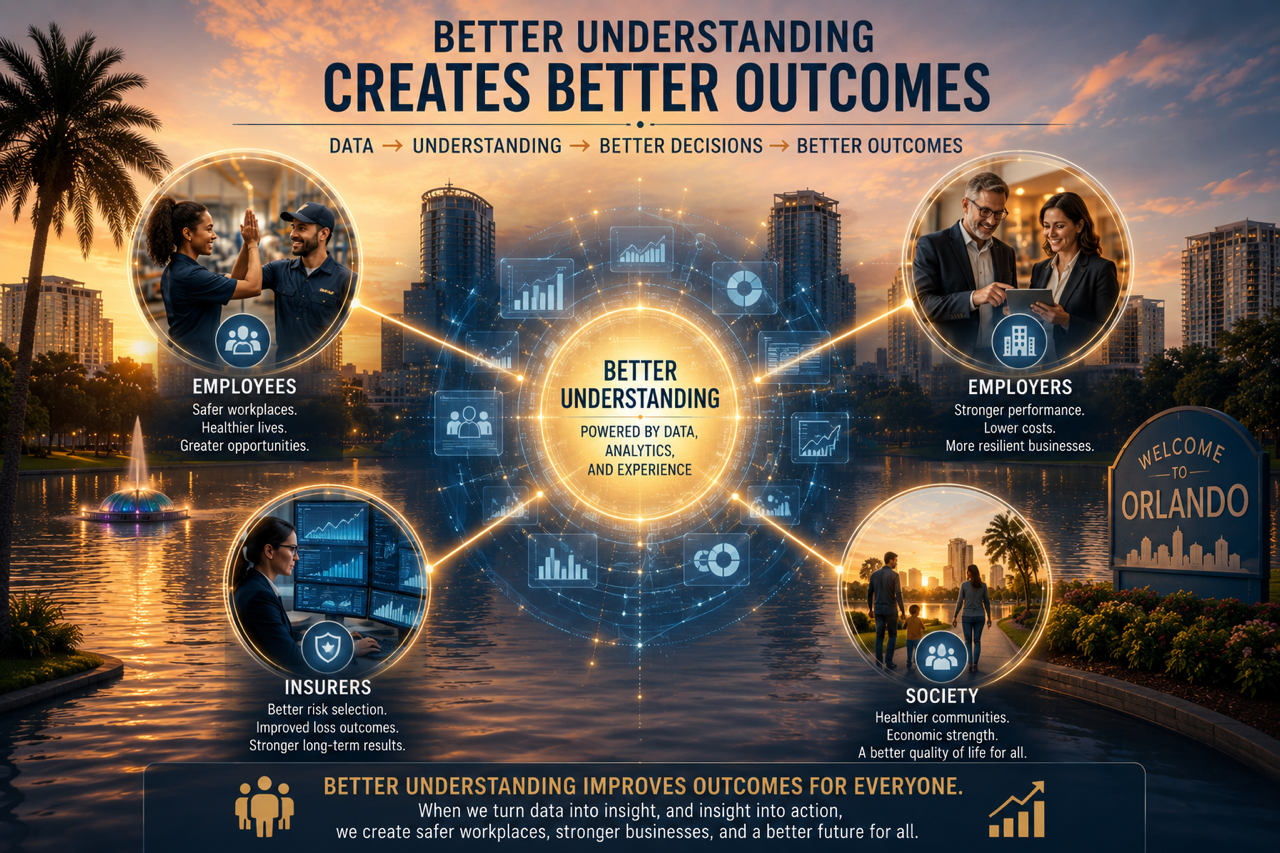
Better data helps organizations recognize patterns that were previously invisible.
Better analysis helps employers make more informed decisions regarding hiring, onboarding, training, supervision, and employee retention.
Those decisions can lead to fewer injuries, healthier workplaces, stronger employee engagement, improved productivity, and more sustainable businesses.
That is why advances in actuarial science, predictive analytics, and underwriting matter. Not simply because they improve pricing, but because they improve understanding.
And better understanding creates opportunities to build workplaces that are safer, healthier, and more rewarding for employees while producing stronger outcomes for employers, insurers, and the workers’ compensation system as a whole.
Looking Forward
Workers’ compensation underwriting is steadily moving beyond simply measuring what happened.
The future increasingly involves understanding why it happened. That understanding creates extraordinary opportunities for organizations willing to apply what the data reveals.
Employee turnover is often viewed as an HR issue.
It is also an operational issue.
A productivity issue.
A training issue.
And a workers’ compensation issue.
Organizations that improve retention may gain benefits that extend far beyond recruiting and hiring costs.
They may also create safer, more experienced, and more predictable workforces.
As our understanding of workforce dynamics continues to evolve, so too does our ability to build environments where employees thrive, businesses perform more consistently, insurers allocate capital more effectively, and fewer families experience the disruption of a workplace injury.
Ultimately, that is the promise of better data—not simply more accurate underwriting, but healthier, safer, and more rewarding workplaces for everyone.