
Reni Snider, Senior Account Executive, Libertate Insurance
A payroll total tells us how much an employer paid. It leaves considerable room for questions about the workforce earning it.
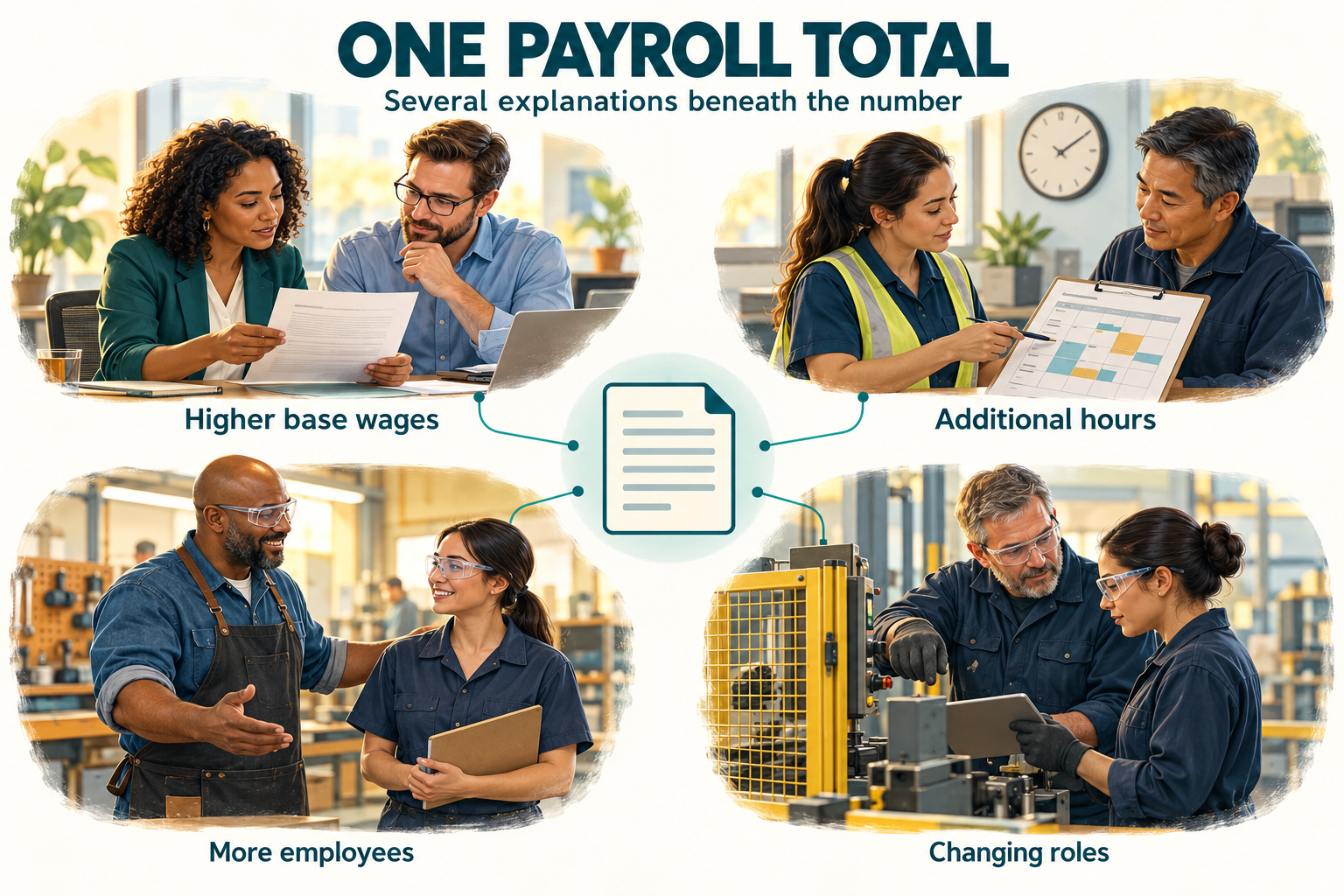
How many people performed the work? How many hours did they work? What responsibilities did they carry? Were earnings driven by higher base wages, extensive overtime or a changing mix of jobs?
For workers’ compensation, those details deserve attention.
Throughout this series, we have explored how workforce characteristics and operational information might contribute to a more complete understanding of risk. Employee wages belong in that discussion, both because of their established relationship with benefits and because of the questions they raise about the employment environment.
The opportunity begins with looking beneath the total—and using what we learn to strengthen the work ecosystem around employees.

Understanding the Distribution
Wage bands group employees into defined earnings ranges. Examining the distribution of employees across those ranges can reveal differences that an average—or a total—obscures.
But the measurement needs a clear definition.
Hourly base pay, weekly earnings and annual earnings describe different things. An employee with low annual earnings may have joined the company recently or worked a limited schedule. High weekly earnings may reflect substantial overtime rather than a high base wage.
Comparisons also need context. A particular hourly rate can occupy very different positions in different occupations and labor markets.
Before asking whether wage bands contribute useful information about workers’ compensation, we need to establish what those bands actually measure. Then we can ask how that information might help employers make better decisions about staffing, training, workload and support.
What We Already Know
The connection between wages and indemnity costs is already built into the benefit structure. Wage-replacement payments generally increase proportionally with earnings until statutory limits apply, subject to the applicable jurisdiction’s benefit provisions.
NCCI’s June 2026 research, The Relationship Between Benefits and Wages, observed a corresponding pattern: average indemnity severity generally increased across wage tiers before flattening at higher earnings levels. Statutory benefit maximums help explain that pattern, although NCCI cautions that they may not fully explain it.
Total indemnity cost also reflects benefit duration and the types of benefits paid. The weekly payment calculation establishes part of the relationship, rather than explaining every difference in claim costs.
The study also observed increasing medical severity across wage tiers, even though medical benefits have no direct wage-replacement mechanism. That finding raises questions about other characteristics associated with earnings.
The more useful question for employers is not simply whether wages correlate with claims. It is whether wage information can help identify where the employment system is working well—and where it may need attention.
When the Denominator Changes
Consider an employer whose staffing, hours and duties remain unchanged while every employee receives a raise.
If the number of claims also remains unchanged, claims per payroll dollar will decline. The calculation improves without demonstrating any reduction in injury occurrence.
This mathematical illustration shows why the denominator matters.
Claims per payroll dollar, claims per employee and claims per hour worked answer different questions. Each can contribute to an analysis, provided we understand what it measures.
The details matter as compensation changes. The Bureau of Labor Statistics reported that civilian wages and salaries increased 3.2% over the year ending June 2026. Payroll growth therefore needs interpretation: How much came from wage changes, additional hours, new employees or different work?
An exposure total becomes more informative when we understand what comprises the total. That understanding can also help employers distinguish between a compensation issue and an operational issue.
For example, rising payroll may reflect:
Higher wages that support retention and recognize growing capability.
Overtime that may signal strong demand, inadequate staffing or fatigue risk.
New employees who require structured onboarding and supervision.
Promotions that move experienced workers into more complex or physically demanding roles.
A changing mix of jobs that calls for different training, equipment or safety practices.
The same payroll trend can point to very different actions depending on what is driving it
What Might Wages Help Us Understand?
Beyond benefit calculations, compensation raises questions that connect naturally with earlier topics in this series.
Could pay relative to the local occupational market help explain an employer’s ability to retain experienced employees?
If retention is weak among lower-paid or newer employees, could the employer strengthen onboarding, mentoring or career pathways before turnover creates additional operational strain?
Does wage progression accompany growing task proficiency, or does it reflect promotion into work with different exposures? If employees are moving into more demanding roles, are training, supervision and equipment changing with them?
Could high weekly earnings identify concentrated overtime that deserves closer operational review? If so, the response might include staffing adjustments, schedule changes, cross-training or additional recovery time—not simply a warning about claims.
Does a wide wage distribution reflect career progression, a diverse mix of occupations or something else entirely? A clearer understanding could help employers align pay, responsibilities and development opportunities.
Could wage patterns reveal where employees may need more support to build skills and advance? A strong work ecosystem should not treat compensation only as a cost. It should connect pay with capability, contribution and a realistic path forward.
These are hypotheses worth investigating. Higher wages do not, by themselves, establish safer work. Lower wages do not establish poor management. Compensation may reflect experience, geography, specialized skills, job demands, scheduling and numerous other conditions.
The analytical challenge is determining whether a wage measure contributes additional information after those differences are considered.
The practical challenge is using that information responsibly. A wage pattern should prompt questions, not conclusions. It might lead an employer to review training completion, supervisor coverage, overtime concentration, turnover, job design or access to advancement. It should not be used to label employees or occupations as inherently risky.

From Insight to Action
If wage information is going to improve a work ecosystem, it needs to connect to decisions employers can make.
A PEO or employer might use wage-band information to support a structured review:
1. Identify where the workforce is changing
Look at movement between wage bands, not just the number of employees in each band. Are employees progressing? Are experienced workers leaving? Are new hires concentrated in particular roles or locations?
This can help distinguish a growing organization from one that is repeatedly replacing employees.
2. Connect compensation with capability
Compare wage progression with training, tenure, certifications, job responsibilities and performance development. If pay increases reflect greater responsibility, confirm that employees receive the preparation and support needed for the work.
When employees advance faster than systems do, risk may emerge from the gap.
3. Review workload and scheduling
Examine overtime alongside wage bands, hours worked, staffing levels and injury timing. Concentrated overtime may indicate a temporary business need, but it may also signal chronic understaffing or insufficient cross-training.
The appropriate response may be operational rather than financial: rebalance schedules, add capacity, rotate demanding tasks or build a deeper bench of qualified employees.
4. Strengthen onboarding and supervision
If lower-paid or newer employees are concentrated in higher-exposure work, employers can examine whether onboarding, job instruction and supervisor access are adequate.
That does not mean assuming lower-paid employees are less capable. It means recognizing that employees entering unfamiliar work may need clear expectations, practical training and timely feedback.
5. Build retention and advancement pathways
Wage data can help employers see whether employees have a credible path from entry-level work to greater skill, responsibility and compensation.
Career pathways can support retention, preserve institutional knowledge and reduce the disruption associated with frequent turnover. They can also help employers identify which skills and experiences should be developed before promotion.
6. Use claims as feedback, not just outcomes
Claims data can help test whether these interventions are working. Employers can examine whether changes in training, staffing, scheduling or supervision are followed by changes in claim frequency, severity or duration.
The goal is not to manage employees through a single metric. It is to create a feedback loop in which workforce information leads to practical improvements, and outcomes help refine those improvements.
New Questions, the Same Scientific Discipline
Richer employment records and more powerful analytical tools expand the questions actuaries can investigate. As explored earlier in this series, the scientific discipline remains the same: develop a hypothesis, test it and follow the evidence.
For wage bands, that means asking whether a proposed measure improves prediction beyond information already captured through classification, geography, tenure, operational characteristics and historical losses.
It also means testing the relationship against employers and periods outside the original analysis.
Was the wage information available before the outcome being predicted? Were employees assigned to bands consistently? Does an apparent result persist after accounting for hours worked and changing responsibilities?
Some measures may prove useful. Others may duplicate existing information or fail to remain reliable over time.
The value lies in finding out. But the value for employers also lies in translating credible findings into better questions and better practices.
A model might identify a relationship between overtime and claims. The employer’s next step should not be to penalize employees who work overtime. It should be to ask whether staffing, scheduling, workload or recovery practices can be improved.
A relationship between tenure and outcomes might lead to stronger mentoring or job progression. A relationship between wage growth and changing duties might lead to a review of promotion training. The insight becomes useful when it helps people design a healthier system of work.
Giving Actuarial Science Something to Test
For a PEO interested in supporting that investigation, useful candidate measures could include:
Employee counts and hours worked within consistently defined wage bands.
Median base pay and wage dispersion within comparable occupations and locations.
Wage progression over time, distinguished from promotions and changes in duties.
Overtime hours and their contribution to weekly earnings.
Retention, training completion and claim outcomes across comparable groups.
Movement between roles, wage bands and levels of responsibility.
Supervisor coverage, onboarding duration and access to job-specific instruction.
Schedule patterns, staffing levels and the concentration of demanding work.
Claim outcomes would also need careful definition. Claim occurrence, medical severity, indemnity severity and disability duration should be examined separately, with appropriate consideration of claim development.
These are potential research inputs. They are not a validated underwriting scorecard or a recommendation to assign favorable treatment to a particular wage band.
They are also not a substitute for conversations with employees and managers. Quantitative information can show where to look. People closest to the work can often explain what is happening and what would help.
An Opportunity Within PEO Records
PEOs may be able to connect information that otherwise sits in separate systems: payroll histories, employment dates, hours, job records, training, turnover and claims.
That connection could help address a meaningful research challenge.
NCCI’s wage study included approximately 20% of claims, representing more than 67% of losses. Estimating frequency required external workforce wage distributions because detailed employee wages were unavailable for most underlying payroll exposure.
Where sufficiently complete records exist, could PEO datasets support more direct examination of earnings and exposure across the workforce, including employees who never experience a claim?
The possibility deserves investigation. Consistent definitions, reliable identifiers, appropriate permissions and enough comparable observations would be necessary. A large dataset alone would not resolve those requirements.
PEOs could also help turn analysis into action by giving employers a practical framework for reviewing workforce patterns. A report might show that overtime is concentrated among a small group of employees. The next conversation could focus on staffing, cross-training and schedule design. It might show that employees are advancing into higher-paid roles without corresponding changes in training. The next step could be a promotion-readiness process.
In that way, data becomes part of an ongoing partnership rather than a one-time assessment.
Looking More Closely at Employment
Compensation is part of the employment relationship. Understanding it alongside training, supervision, workload and workforce stability may help employers ask better questions about their businesses today.
It can also help them build a more resilient work ecosystem—one in which employees understand how to succeed, managers have the support to lead effectively, workloads are sustainable, skills are developed and advancement is possible.
For PEOs, that creates an opportunity to bring employment expertise closer to the decisions small businesses make every day: how they recruit, develop, compensate and retain the people performing their work.
Whether particular wage measures ultimately improve workers’ compensation prediction remains a question seeking evidence.
How employers use the insight is a more immediate opportunity. We owe it to the American SMB workforce to grasp those opportunities and make the most of them today.
Looking beneath total payroll can help reveal where an organization may need better staffing, stronger training, clearer career pathways or more sustainable work design. Used carefully, wage information can support not only better risk analysis, but better employment practices.
The broader ambition is already clear: help employers build workplaces where people can work safely, develop their capabilities and build a future.
Looking beneath total payroll gives us another place to begin—and another way to improve the system around the people doing the work.
