
The Evolution of Actuarial Science: New Tools, New Questions, Same Scientific Method
Reni Snider, Senior Account Executive, Libertate Insurance

While researching the next installment of my PEO Compass series, I found myself asking a question that extends well beyond any single underwriting variable:
What happens to a mature scientific discipline when it suddenly gains access to richer data and dramatically more powerful tools?
Workers' compensation underwriting has always been about one thing; predicting the future.
Every underwriting submission, experience modification, loss trend, and actuarial model exists for the same fundamental purpose—to estimate tomorrow's risk using today's evidence. This truth remains constant. What is changing, however, is the amount of evidence available to evaluate.
For generations, actuaries have relied on reliable, consistently collected datasets to identify patterns, quantify uncertainty, and estimate future outcomes. Payroll, industry classification, historical losses, experience modification factors, claim development, and countless other variables have long served as the foundation of workers' compensation pricing.
The science itself hasn't changed. The laboratory has.
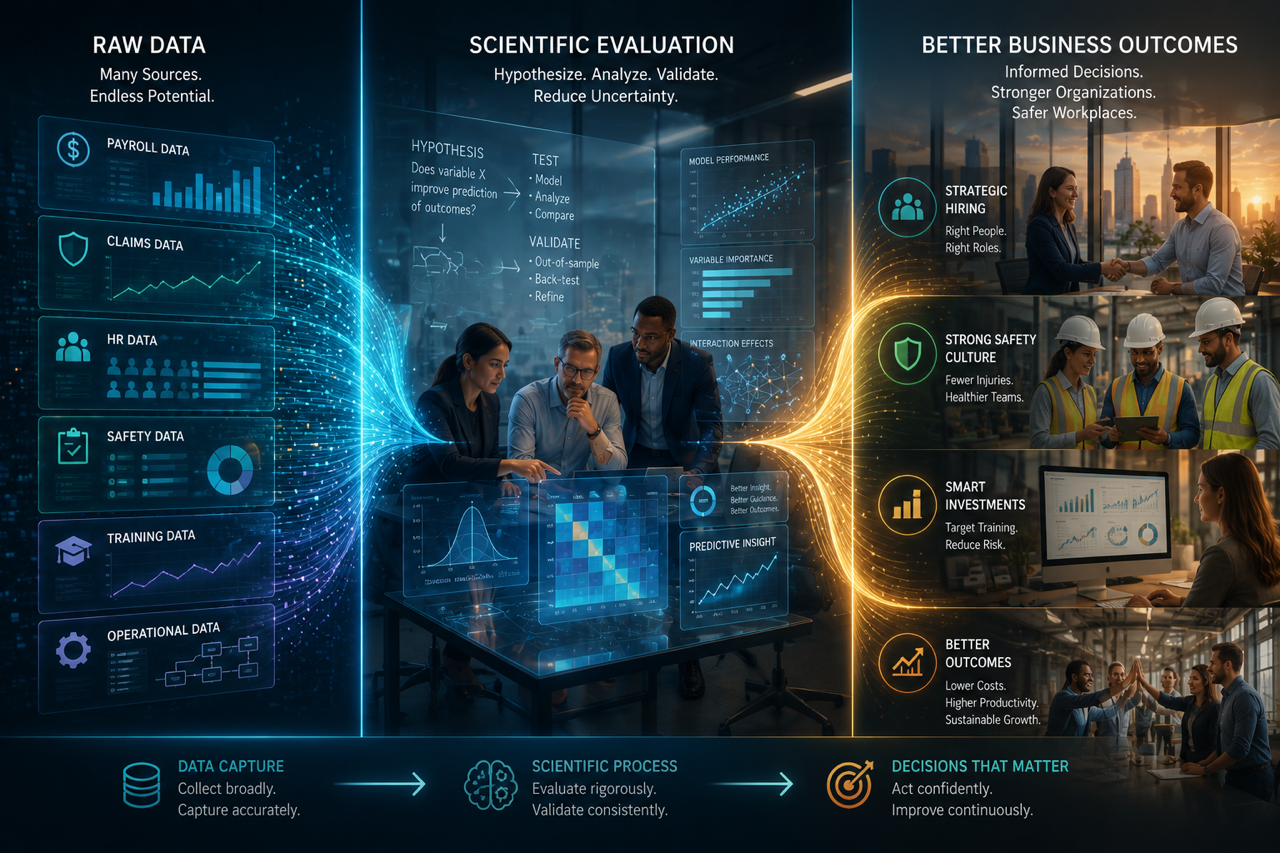
Organizations now collect exponentially more operational data than they did even a decade ago. Human resource information systems, payroll platforms, learning management systems, applicant tracking software, claims platforms, safety management tools, and countless other technologies now generate structured data describing nearly every aspect of how organizations operate.
At the same time, advances in cloud computing, artificial intelligence, machine learning, and computational power have dramatically expanded our ability to organize, analyze, and evaluate those datasets.
Recent actuarial literature is exploring how emerging analytical techniques can augment traditional actuarial methods while preserving the profession’s emphasis on transparency, governance, and expert judgment.
These developments significantly bolster actuarial science by profoundly expanding the number of questions actuarial science can investigate.
The Scientific Process Has Always Been the Foundation
There is a tendency to describe artificial intelligence as though it represents a new era of underwriting, but that’s not accurate.
Long before anyone discussed AI, actuaries were already practicing science.
They observed patterns.
They developed hypotheses.
They collected data.
They tested assumptions.
They measured outcomes.
They refined their models.
Then they repeated the process.
That cycle has defined actuarial science for generations and resulted in great success in this field of study.
The objective remains exactly the same today.
Estimate future outcomes as accurately as possible using the best evidence available.
The difference is that actuaries now have access to more potential evidence than ever before.
Every New Dataset Begins as a Question
As organizations digitize more aspects of their operations, entirely new categories of information become available for analysis.
Hiring velocity.
Employee tenure.
Workforce demographics.
Training completion.
Return-to-work performance.
Geographic concentration.
Supervisor experience.
Payroll trends.
Operational workflows.
The availability of these datasets naturally leads to an important question:
Could any of these characteristics improve our ability to predict future workers' compensation outcomes?
Notice the wording.
Not *do* they improve prediction.
*Could* they?
That distinction matters.
Scientific discovery doesn't begin with certainty, …it begins with curiosity.

Before There Is Evidence, There Is Judgment
While discussing this topic recently, my colleague Paul Hughes made an observation that perfectly captures the challenge facing actuaries today:
"No data exists in using new data in projecting outcomes." — Paul Hughes
At first glance, the statement almost feels contradictory, but it perfectly describes the earliest stage of scientific discovery.
The first time an actuary evaluates a new operational variable, there is no historical evidence demonstrating whether that variable contributes meaningful predictive value.
Someone must first recognize the possibility.
Someone must decide the question is worth asking.
Someone must develop a way to test it.
Only after repeated observation, statistical analysis, validation, and refinement does a promising hypothesis become an accepted actuarial tool.
This isn't a weakness in the scientific process.
It's exactly how the scientific process works.
The Bottleneck Is Changing
For much of actuarial history, the greatest constraint wasn't statistical capability, it was information. Models could only evaluate variables that were consistently collected, accurately maintained, and computationally practical to analyze.
Today, those constraints are changing. Organizations routinely capture operational information that would have been unavailable—or unusable—only a generation ago.
Cloud computing has dramatically reduced storage constraints. Artificial intelligence can rapidly organize and summarize enormous volumes of structured and unstructured information. Machine learning makes it increasingly practical to explore relationships among thousands of variables simultaneously.
Recent actuarial research has demonstrated that machine learning techniques can uncover complex nonlinear relationships and interaction effects that are difficult to capture using traditional generalized linear models, while still preserving the transparency required for actuarial practice.
For perhaps the first time, the limiting factor is becoming less about whether data exists and more about deciding **which questions are worth asking.**
That is an extraordinary moment for any scientific discipline.
More Data Doesn't Automatically Produce Better Predictions
The current enthusiasm surrounding artificial intelligence has created an understandable misconception:
If more data exists, predictions must automatically become better.
Reality is rarely that simple.
Every additional dataset introduces both opportunity and complexity.
Some variables will ultimately prove to have little or no predictive value.
Others may simply duplicate information already captured elsewhere.
Some may appear meaningful within one industry but not another.
Others may seem predictive during one economic cycle only to lose significance as conditions change.
Finding meaningful signal among expanding amounts of information is becoming one of the profession's greatest opportunities—and one of its greatest challenges.
This emphasis on balancing predictive performance with interpretability, governance, and scientific rigor is a recurring theme throughout recent actuarial literature.
That is where actuarial science matters most.
The Future May Belong to Relationships Rather Than Individual Variables
Historically, underwriting has often focused on evaluating individual characteristics.
Increasingly, the greatest opportunity may lie in understanding how those characteristics interact.
Perhaps hiring velocity by itself tells only a small part of the story.
Perhaps workforce demographics alone provide limited additional insight.
Perhaps geographic concentration, viewed independently, contributes very little.
But what happens when those characteristics are evaluated together?
Could certain combinations reveal organizational patterns that no single variable captures independently?
These are precisely the types of questions that today's analytical tools make increasingly practical to investigate.
Rather than replacing established actuarial techniques, many researchers now view machine learning as a means of identifying candidate relationships that can strengthen traditional actuarial models through careful validation and expert oversight.
Whether those relationships ultimately improve predictive accuracy remains an empirical question.
That's not a limitation.
It's the next experiment.
What This Means for Employers
Most employers don't need to understand the mathematics behind actuarial modeling.
They do benefit from understanding the direction in which underwriting continues to evolve.
Organizations that consistently collect accurate operational data, invest in thoughtful hiring practices, build strong safety cultures, retain experienced employees, and document how their businesses operate are creating something valuable regardless of where actuarial science ultimately lands.
They're building organizations that are easier to understand.
For businesses operating within the PEO marketplace, that also reinforces the value of partnering with insurance professionals who specialize in PEO workers' compensation.
The PEO market has always required a specialized understanding of co-employment structures, carrier appetites, class code strategy, underwriting philosophy, and operational risk. As underwriting continues to explore richer operational datasets, that specialization becomes even more valuable.
Experienced advisors understand how underwriters evaluate risk, which operational characteristics deserve attention, and how to present an organization's story with clarity, context, and credibility.
Better data has value.
Knowing how to communicate that data effectively has value, too.
The Next Chapter
Workers' compensation underwriting has always sought to answer the same question:
Based on everything we know today, what is the most accurate estimate of tomorrow's risk?
That question has not changed.
The scientific method has not changed.
Neither has the actuarial profession's commitment to evidence over assumption.
What has changed is the environment in which that science operates.
Actuaries now possess better tools.
Organizations now generate richer operational data.
Technology allows hypotheses to be explored faster and more thoroughly than ever before.
None of that guarantees better predictions.
Many new variables will ultimately prove unimportant.
Others may provide only incremental improvements.
Some ideas that seem promising today may not withstand rigorous testing.
That is not failure.
That is science.
The future of workers' compensation underwriting won't be determined simply by who has the most data or the fastest algorithms.
It will belong to those who ask the best questions, test them rigorously, and remain willing to follow the evidence wherever it leads.
Because actuarial science has never been about predicting the future with certainty.
It has always been about reducing uncertainty through evidence.
Today's tools simply give us more opportunities to discover where that evidence may be hiding.
The actuarial profession appears to be entering a period defined by expanding the scope of scientific inquiry itself, and that’s exciting.