
Labor Market Signals Remain Soft: Insights from NCCI’s Latest Report
The labor market continues to shift in real time, and for workers’ compensation, these changes matter. Hiring trends, wage patterns, and overall employment levels directly influence payroll exposure, claim frequency, and long-term pricing trends. In its latest Labor Market Insights update, NCCI highlights how industry leaders can interpret current conditions, especially while official government employment data remains temporarily unavailable.
Rather than waiting in the dark, NCCI’s economics team turned to trusted third-party indicators to track how the labor market is moving. While these sources are not perfect substitutes, they offer useful signals that trend in the same direction over longer periods.
What is the alternative data showing?
With traditional government datasets paused, NCCI is relying on three main third-party indicators to track month-to-month movement:
1. ADP Employment Report
Payroll services provider ADP reported a 29,000 job decline in September, followed by a 42,000 job gain in October.
This reversal suggests volatility, but not a clear upward or downward trend.
2. Revelio Labs Workforce Data
Revelio’s Public Labor Statistics Report found that employment grew by 33,000 jobs in September, then declined by 9,100 in October. Again, movement, but no strong directional shift.
3. Indeed Hiring Lab
Indeed’s Hiring Lab offers insight into job postings and wage behavior.
Their latest report shows:
· Job postings continue to decline
· Wage growth is slowing down
This reflects a softer labor market where hiring demand is cooling and wage pressure is easing.
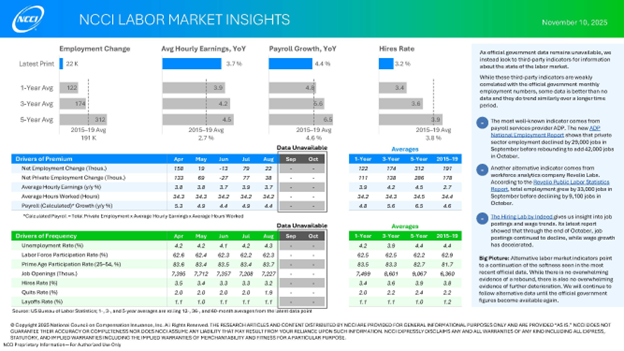
Image Source: ncci.com/Articles/Documents/Labor-Market-Insights-Dashboard-November-2025.pdf
What this means for workers’ compensation?
The labor market is not showing signs of a sharp downturn, nor is it showing signs of a strong recovery. For workers’ compensation stakeholders—particularly PEOs—this middle ground matters.
A softer labor market often leads to:
· Slower payroll growth, which can impact premium volumes
· Shifted risk profiles, as industries with fluctuating demand adjust staffing
· Moderated wage inflation, which affects indemnity cost trends
· Potential lagging effects on claim frequency, depending on hiring patterns in high-risk roles
For PEOs, understanding these movements helps with forecasting, budgeting, and advising client employers on workforce planning.
The big picture
NCCI’s takeaway is clear: The alternative indicators point to continued softness, like what the most recent official data suggested. There is no strong evidence of a rebound, but also no evidence of significant deterioration.
Until federal reporting returns, these alternative sources give PEOs and employers a useful snapshot of where the market is heading, helping them plan staffing, budgeting, and risk exposure with more confidence.